


LSR Overmolding: Benefits, Materials and Applications
Reading Time: 6 minutes
Last Updated on August 20, 2026
Manufacturers frequently use LSR overmolding to mold liquid silicone rubber (LSR) over a compatible substrate, such as plastic or metal, to enhance the final product’s properties, functionality and design. The process can combine the flexibility and durability of silicone with the structural properties of a rigid substrate in a single component.
Self-adhering LSR can further simplify the overmolding process by bonding directly to compatible substrates without separate primers or surface pretreatments. This can reduce manufacturing steps while enabling durable hard/soft components for automotive, medical, industrial and consumer applications.
Wacker Chemical’s high-performance ELASTOSIL® LR 3078 is a self-adhering liquid silicone rubber designed to extend LSR overmolding to challenging substrates, including polycarbonate and other high-performance plastics that can present compatibility and adhesion challenges.
What Is LSR Overmolding?
LSR overmolding is a manufacturing process in which liquid silicone rubber is molded onto another substrate to create a multi-material component. Depending on the LSR and substrate, the silicone can bond directly to materials such as thermoplastics, metals or glass.
The process is particularly useful for hard/soft combinations that require the structural properties of a rigid material together with silicone’s flexibility, temperature resistance, durability or tactile properties.
In automated two-component, or 2K, injection molding, the substrate and LSR can be combined efficiently within the molding process, helping manufacturers integrate complex geometries and multiple functions into a single part.
What are the Benefits of LSR Overmolding?
LSR overmolding combines the properties of liquid silicone rubber with the functionality of another substrate. Depending on the material and application, key benefits can include:
- Design flexibility: LSR is available in translucent and custom colors or tints, enabling intricate designs and finishes for consumer goods, medical products and other applications.
- High- and low-temperature performance: LSR remains flexible across a broad temperature range, supporting reliable performance in demanding conditions.
- Durability: Resistance to wear, tear and aging supports long-term use.
- Biocompatibility: Appropriate LSR grades can meet requirements for certain medical applications.
- Functional versatility: LSR overmolding can combine rigid and flexible materials in one component to enhance functionality and performance.
- Environmental and chemical resistance: LSR provides resistance to heat, UV light, weathering, chemicals and abrasion.
- Manufacturing efficiency: Self-adhering grades can eliminate separate priming or surface-treatment steps for compatible substrates, reducing process complexity and cost.
How Does Self-Adhering LSR Improve Overmolding?
Conventional silicone overmolding can require additional surface preparation to establish a secure bond between the LSR and substrate. Self-adhering LSR is formulated to bond directly to compatible materials, potentially eliminating these additional processing steps.
ELASTOSIL® LR 3078 is a self-adhering, two-component LSR consisting of a silicone base and a curing agent or hardener. It provides excellent mechanical and electrical properties and expands the capabilities of traditional LSRs to accommodate new hard/soft combinations.
The material is particularly suitable for high-volume production of overmolded thermoplastic/elastomer parts and can be used in co-molding processes under standard conditions without special treatment of the mold surface.
Can LSR Be Overmolded Onto Polycarbonate?
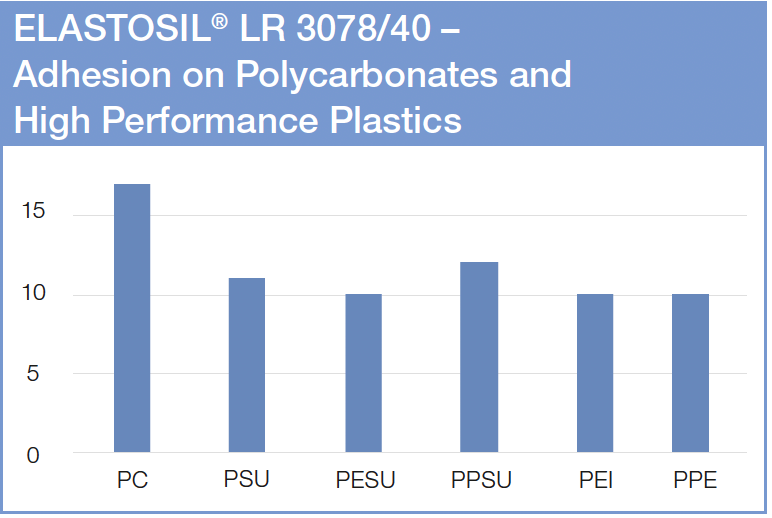
Yes. Certain self-adhering LSR grades are designed for LSR overmolding onto polycarbonate without requiring pretreatment of the thermoplastic substrate. ELASTOSIL® LR 3078 provides strong adhesion to polycarbonate without requiring substrate pretreatment. This enables hard/soft combinations that can be difficult to achieve with conventional LSR grades.
These self-adhesive silicones are well suited for fully automated, two-part injection molding, which can enable efficient production of LSR-overmolded components.
What Materials Can Be Used?
The suitable materials depend on the silicone formulation and required adhesion. ELASTOSIL® LR 3078 can adhere to metals, glass and several plastics, including challenging high-performance thermoplastics. Compatible substrates identified in the current article include:
- Polycarbonate (PC) (e.g., Apec® 1745, Makrolon® 2405, etc.)
- Polyphenylene ether (PPE)
- Polysulfone (PSU)
- Polyether sulfone (PESU)
- Polyphenyl sulfone (PPSU)
- Polyether imide (PEI)
This substrate versatility can expand design possibilities for hard/soft components in applications requiring both rigid structural materials and flexible silicone surfaces.
Can LSR Overmolding Eliminate Primers and Pretreatment?
Certain self-adhering LSR grades can eliminate primers or pretreatment when used with compatible substrates. Creating a secure bond between silicone and polycarbonate can require significant effort. Traditional silicones often need a primer coating or plasma treatment to activate the surface, adding cost and complexity.
ELASTOSIL® LR 3078 does not require a primer for compatible substrates. Its direct-bonding technology enables the silicone to adhere to rigid substrates such as thermoplastics, polycarbonate and glass without a separate bonding primer. Eliminating a separate priming step can reduce processing time, labor and manufacturing complexity.
How Does Self-Adhering LSR Improve Bond Strength?
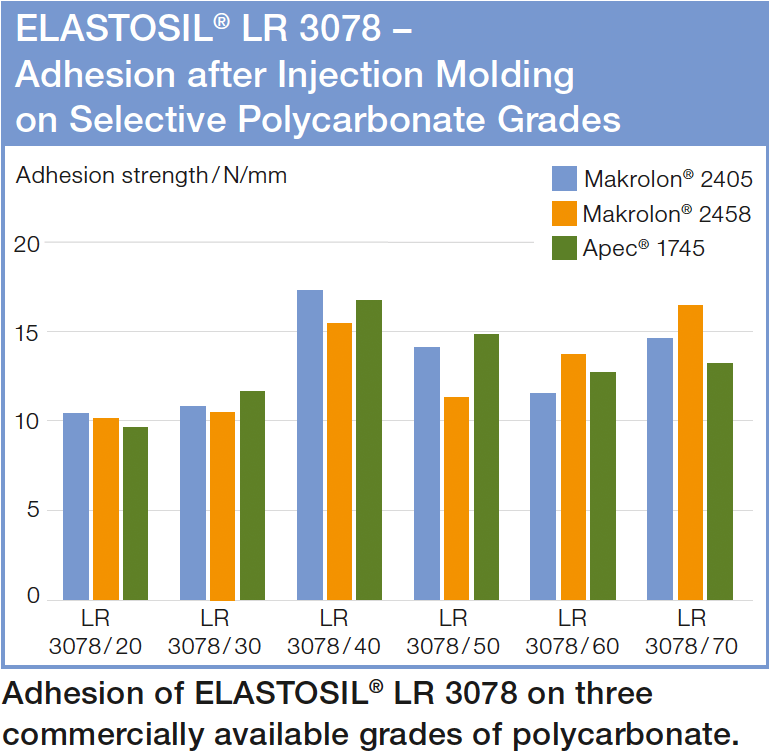
ELASTOSIL® LR 3078 achieves high adhesion values before the component is removed from the injection mold. At the same time, the LSR does not adhere to the metal mold, helping manufacturers demold hard/soft composites without secondary finishing. The formulation is also free of bisphenol A (BPA)-based adhesion promoters.
Can LSR Overmolding Reduce Cycle Times?
LSR overmolding can support efficient production when the silicone formulation provides fast curing and direct adhesion. ELASTOSIL® LR 3078 cures quickly, enabling short cycle times and high productivity, even at relatively low processing temperatures. The cured rubber provides excellent mechanical properties without requiring post-curing.
Lower-temperature processing also makes the grade useful with polycarbonate and other heat-sensitive plastics that may not tolerate excessively high processing temperatures. The cured rubber can be steam sterilized at 134 °C without compromising its mechanical properties or adhesion to plastic substrates.
What Are Common Applications?
The flexibility, biocompatibility, temperature resistance and mechanical properties of appropriate LSR grades make the process useful across a variety of industries.
- Automotive: Seals, gaskets and weatherproofing components requiring flexibility and resistance to demanding conditions.
- Medical devices: Seals for medical packaging and components for surgical instruments, diagnostic tools and equipment.
- Food-contact applications: Seals and components for kitchen appliances when an appropriate compliant grade is selected.
- Industrial equipment: Molded components for pumps and valves, as well as electrical connectors.
- Consumer electronics: Grips, cases and buttons that combine durability with a tactile surface.
For medical applications, ELASTOSIL® LR 3078 is available with specific biological-safety qualifications. Manufacturers should verify the particular grade and applicable requirements for the intended device or application.
How Do You Select an LSR Grade for Overmolding?
Selecting an LSR for overmolding requires matching the material to both the substrate and manufacturing process. Important factors include:
- Adhesion to the substrate
- Viscosity and flow characteristics
- Hardness
- Curing time and temperature
- Mechanical properties
- Part geometry
- Production volume
- End-use and regulatory requirements
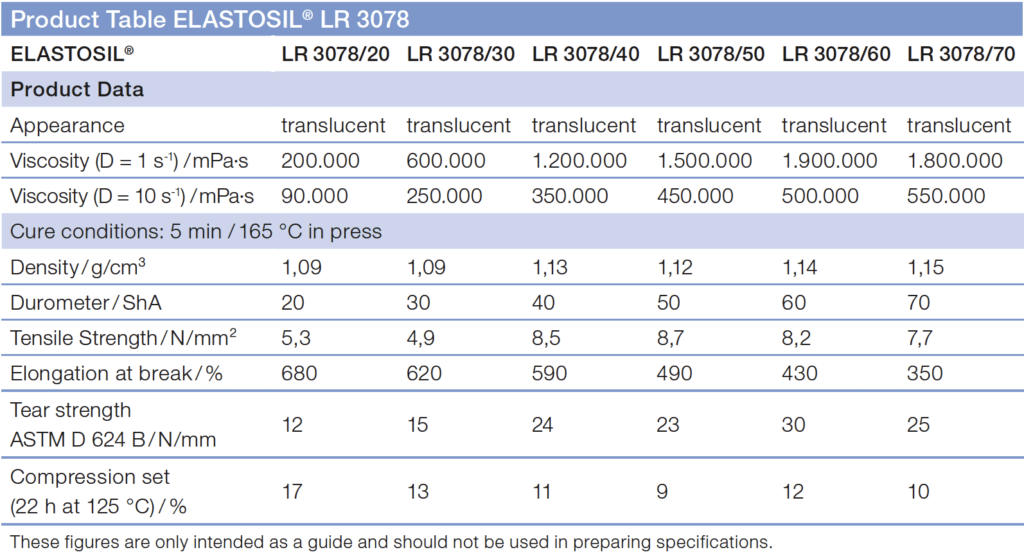
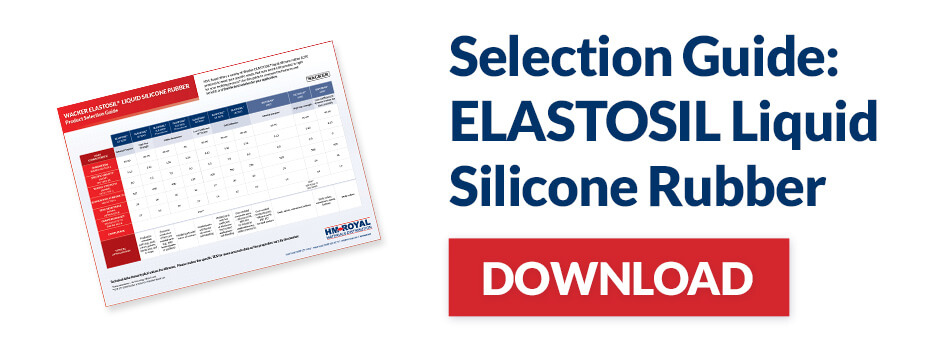
ELASTOSIL® grades vary in viscosity, hardness and curing time, allowing manufacturers to tailor processing to specific applications. Medium- to high-viscosity grades can be suited to particular molding applications, while lower-viscosity variants provide greater flowability for intricate designs. Curing behavior, temperature resistance and mechanical properties also vary by grade.
Expand LSR Overmolding with Self-Adhering Silicone
ELASTOSIL® LR 3078 provides direct adhesion to challenging substrates such as polycarbonate and other high-performance thermoplastics. Its self-adhering formulation can eliminate separate priming steps while supporting automated 2K injection molding, short cycle times and durable hard/soft components.
For manufacturers evaluating LSR overmolding, selecting the right silicone requires consideration of substrate compatibility, adhesion, processing conditions and finished-part requirements.
H.M. Royal is a partner of Wacker Chemical and provides ELASTOSIL® liquid silicone rubber grades for a range of overmolding applications. Contact an H.M. Royal specialist for assistance in selecting the right grade and quantities for your application.
Frequently Asked Questions About LSR Overmolding
What is LSR overmolding?
The process of molding liquid silicone rubber over a compatible substrate, such as plastic or metal, to create a multi-material component. It allows manufacturers to combine a rigid substrate with silicone’s flexibility, durability and environmental resistance.
What is the difference between LSR overmolding and silicone overmolding?
Silicone overmolding is the broader term for molding silicone onto another substrate. LSR overmolding specifically uses liquid silicone rubber. LSR’s low viscosity and compatibility with automated injection molding make it useful for producing complex, high-volume overmolded components.
Can LSR be overmolded onto plastic?
Yes. Compatible LSR formulations can be overmolded onto thermoplastics. ELASTOSIL® LR 3078, for example, provides adhesion to polycarbonate and high-performance plastics including PPE, PSU, PESU, PPSU and PEI.
Does LSR overmolding require a primer?
It depends on the LSR and substrate. Conventional silicone may require a primer or plasma treatment to establish adhesion. Self-adhering LSR grades such as ELASTOSIL® LR 3078 can bond directly to compatible substrates without a separate primer.
What are the advantages of self-adhering LSR?
Self-adhering LSR can eliminate separate priming or surface-treatment steps, simplifying production. It can also support automated two-component molding and strong adhesion between silicone and compatible rigid substrates.
What is 2K LSR overmolding?
Two-component, or 2K, injection molding combines two different materials within the molding process. This approach can combine a rigid thermoplastic substrate and flexible silicone into a single hard/soft component while supporting automated production.
What industries use LSR overmolding?
It is used in automotive, medical, food-contact, industrial and consumer-electronics applications. The appropriate LSR grade depends on the substrate, manufacturing conditions, performance requirements and applicable regulatory requirements.


