How a Mold Release Agent Improves Rubber-to-Substrate Bonding
Reading Time: 3 minutes
Last Updated on June 9, 2026
Rubber-to-substrate bonding is a common process used by compounders to join rubber to materials such as metals, plastics, and fabrics into a single, integrated part. Many industries use this process to manufacture products such as engine mounts, seals, gaskets, bushings, rollers, pump parts and encapsulated electrical assemblies.
Mold release agents play a key role in this process by enabling clean part removal while maintaining strong adhesion to the substrate. These agents form a thin, durable layer on the mold surface that prevents sticking without interfering with bonding.
What is a Mold Release Agent?
During the curing stage of rubber-to-substrate bonding, the rubber becomes soft and tacky, increasing the risk of sticking to the mold. To prevent this, mold release agents are applied to the mold to ensure smooth, efficient part removal.
Before trialing a new mold release agent, it’s important to thoroughly clean the mold to remove any residue, carbon buildup and other surface contaminants that could affect performance. Mold release agents can either be solvent-based or water-based, and both form a protective barrier.
In most cases, the release agent is applied manually with a spray gun or through an automated process. Some operations use programmable spray systems with multiple spray nozzles, allowing for precise and consistent application.
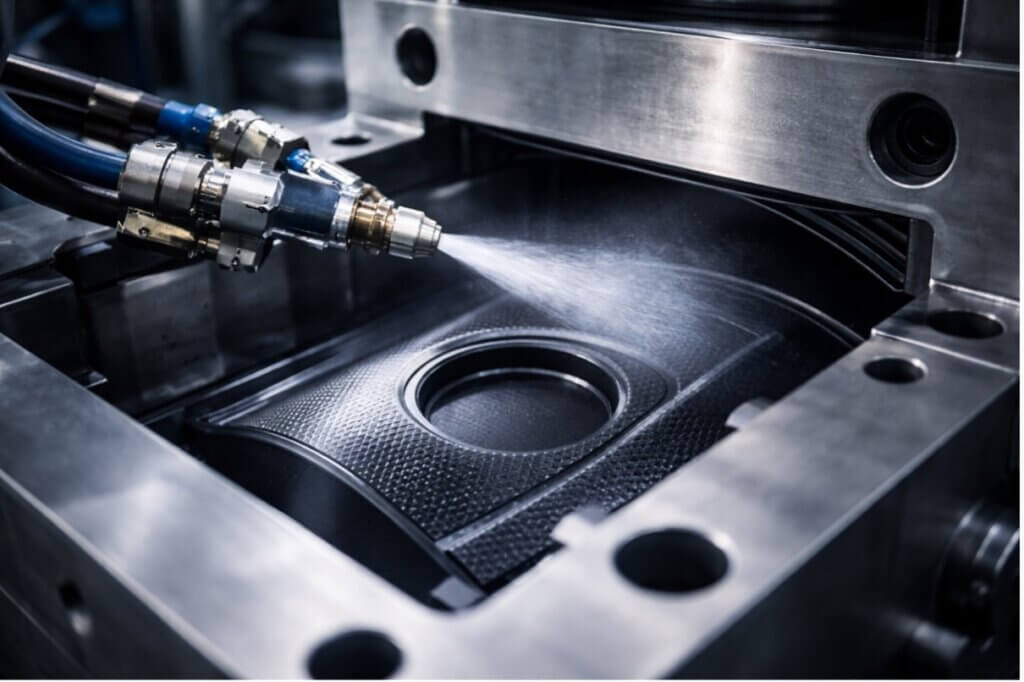
The Role of Mold Release Agents
Without the proper mold release agent, parts can stick to the mold, leading to tearing and surface defects during removal. Over time, this can also contribute to mold fouling, where residue builds up, further increasing sticking and reducing process efficiency.
In addition to acting as a physical and chemical barrier between the mold and rubber, mold release agents provide several important benefits:
- Help control adhesion between the mold surface and rubber.
- Improve product quality by preserving part geometry, gloss, and surface texture.
- Reduce defects and scrap caused by sticking or tearing.
- Prevent buildup on mold surfaces, minimizing long-term fouling.
- Extend tool, die and mold life by reducing wear and contamination.
- Offer low to no VOC emissions, supporting a cleaner working environment.
- Increase production efficiency through more consistent output and less downtime for mold cleaning.
Types of Mold Release Agents
Mold release agents are available in a variety of formulations to suit different applications and processing needs. The most common types include:
- Water-based: These formulations contain active ingredients that are emulsified in water. They are more environmentally friendly due to little or no VOC emissions, zero flammability and fewer fumes. However, they are more complex to manufacture and can be more sensitive in use, as residual moisture can interact with the material being molded.
- Solvent-based: In these systems, the active components are dissolved or dispersed in a solvent or blend of solvents. They are easier to apply and support strong, uniform film formation. Their evaporation rate can be tailored through solvent selection, and they are highly effective for part release with long service life. However, they are less environmentally friendly and come with greater health and safety considerations.
- Silicone: Silicone release agents provide excellent release performance, especially for difficult applications. Depending on the type or amount of silicone in the mold release agent, they can make downstream processes such as painting, coating, or bonding, more challenging due to residual surface contamination.
- Silicone-free: These are designed to minimize oily residue, making post-processing steps like painting or coating easier. They also reduce the risk of contamination and can eliminate additional cleaning steps, saving time and cost in production.
- Carrier-free: Typically supplied as solid, powder-based materials, these agents are applied using electrostatic spray. They offer a cleaner application with no vapor emissions or liquid waste streams and can reduce noise during application. However, if not applied correctly, they may create dust hazards.
Choosing the Right Mold Release Agent
Choosing the right mold release agent depends on several factors, including the composition of the mold material, its physical properties, and the specific requirements of the process. Different materials, such as metal alloys, thermosets, thermoplastics, and elastomers, have unique molding conditions and processing demands.
Selecting the appropriate release agent is important for smooth processing and minimizing the risk of part contamination. If the release agent is not chemically compatible with the material, it can create issues in downstream operations, such as bonding, coating or painting.
When evaluating a mold release agent, it’s important to consider:
- Mold material and geometry
- Process conditions, including temperature, pressure, cycle time, and molding method
- Post-molding operations, such as adhesion or coating requirements
- Desired performance and productivity, including the number of acceptable parts produced over time
- Existing process issues, such as poor cavity filling, sticking or scrap related to release issues
- Frequency of mold cleaning and maintenance
- Required part finish, including gloss and surface quality
- Health, safety, and environmental requirements
The growing use of low-VOC, and PFAS-free products, along with increasingly complex mold designs and advanced materials, can make selecting the right mold release agent more complex.
HM Royal can help you navigate these challenges and select the best solution for specific applications. As a trusted supplier of mold release agents from Chem-Trend, L.P., we offer a variety of high-performance products designed to meet the needs of diverse industrial processes.